
Guinea-Bissau electoral commission unable to finalise election results after violent interference
- Guinea bissau News
OurDailyAfrica Reporter
- 0
- 7 minutes read
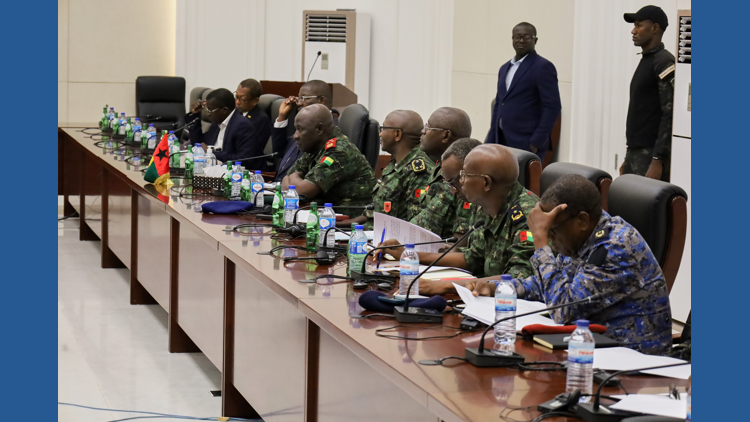
Military officials attend an ECOWAS meeting in Bissau, Guinea-Bissau, Monday, Dec. 1, 2025. (AP Photo/Bubacar Camara)
The outcome of the November 23, 2025 presidential vote in Guinea-Bissau remains unresolved. The country’s electoral authority has declared it cannot complete the process. Armed men stormed the offices of the electoral body, stole ballots and vote tallies, and destroyed key servers. As a result, the election that promised a crucial democratic milestone has turned into a political crisis.
Armed interference halts the vote — election results lost
On November 26, just days after the election, unknown armed assailants broke into the headquarters of the National Electoral Commission (CNE) in Guinea-Bissau. They seized ballots, regional tally sheets and election-related data. In addition, they destroyed the central server where results were stored. Without these essential records, officials said they lacked the material and logistic capacity to proceed. A senior CNE official declared publicly that the electoral process could not continue under the current conditions.
The break-in occurred exactly one day before the commission was due to release provisional results. With those records gone — and no backups to rely on — any official announcement became impossible. The data from multiple regions vanished, leaving only partial records from the capital. That gap undermines the integrity and legitimacy of the vote count.
Power grab complicates the electoral deadlock
The same day the break-in happened, military officers seized power across Guinea-Bissau. They declared suspension of the election process and placed the country under a transitional military government headed by Horta Inta-a. The generals said they were restoring order. However, their takeover has thrown constitutional order into question.
With both main presidential contenders — incumbent Umaro Sissoco Embaló and opposition candidate Fernando Dias da Costa — claiming victory, uncertainty deepened. Yet, in the absence of verifiable results, both claims remain unconfirmed. The situation stands at a volatile impasse.
Why the commission cannot move forward
The CNE explained that virtually all tally sheets from across the country were stolen or destroyed. The main digital server holding results was wiped out. Computers, phones, and other office equipment used by the 45-member staff on duty that day were confiscated.
Without regional tally sheets, the commission lacks any way to reconstruct national vote totals. As one official put it: without those key materials, “it is impossible to complete the electoral process.” The commission’s inability to operate means there is no legitimate route forward — at least until fresh elections or a full recount under safe, verifiable conditions.
Broader political turmoil and implications for Guinea-Bissau
This breach of electoral integrity coincides with renewed military control. The coup has reopened old wounds in a country long plagued by constitutional instability. Since independence, Guinea-Bissau has seen multiple coups and contested elections. This current crisis adds yet another layer of fragility and uncertainty.
The new military government replaced the previous administration with a 28-member transitional cabinet. Officials deposed from government, including the former president, reportedly fled the country. Opposition figures and international actors have condemned the takeover. Meanwhile, the electoral commission remains suspended, and institutions are in limbo.
Risks for citizens, democracy and governance
With election results lost, the people of Guinea-Bissau face serious consequences. First, their vote — cast in hope of representation — may count for nothing. Second, uncertainty breeds instability. Without confirmed leadership, ministries and public services may stagnate or collapse. Third, this episode undermines faith in democratic processes. Citizens may grow disillusioned with voting altogether if outcomes become vulnerable to theft or force.
Moreover, the absence of a legitimate, accepted government can fuel deeper crises. Violence, economic collapse, social unrest or arbitrary rule may follow. Institutions that rely on electoral legitimacy — courts, civil service, public infrastructure — risk breakdown. The country’s fragile governance structure may not withstand prolonged uncertainty.
What needs to happen: paths toward resolution
To restore legitimacy, the following steps are urgent and essential:
- Launch a new, transparent and internationally supervised electoral process. The destroyed tally must be replaced by fresh votes under secure conditions.
- Guarantee full protection for election officials, polling data, and results — both physical and digital. Security must be prioritized to prevent repeats of armed break-ins.
- Release detained political figures and restore civil liberties, media freedom, and public reporting.
- Involve regional and international mediators to oversee constitutionally valid transitional arrangements and schedule credible elections.
- Ensure that results are verified independently and that both national and local stakeholders accept the outcome before reinstating an elected government.
Without these steps, the risk of protracted instability remains high.
Conclusion: A deeply troubled election — loss of ballots, loss of trust
The announcement that the Guinea-Bissau electoral commission is unable to finalise election results marks a moment of historic crisis. The destruction of ballots, tallies, and digital records — combined with a military takeover — has derailed a complex democratic exercise.
For now, the hopes of voters remain unanswered. The integrity of their ballots vanished along with critical data. The future of democracy in Guinea-Bissau now depends on courageous, transparent efforts to rebuild trust, re-conduct elections, and guarantee safe, fair voting.
Unless decisive action follows, the country risks sliding deeper into instability, distrust, and prolonged governance black-out.